Thursday, January 26, 2012

Article


Following one of the longest and weakest periods of activity in many cycles, the Sun is brimming with activity again. In late January 2012, our nearest star offered a preview of what may be to come in the solar maximum of 2012–13. The storm has the potential to disrupt some communications and satellite systems and to bring auroras to high-latitude skies.

The images above show a solar flare as observed by the Atmospheric Imaging Assembly (AIA) on NASA’s Solar Dynamics Observatory (SDO) at 03:27, 03:42, and 04:12 Universal Time (Greenwich Time) on January 23. Note the brightening of the solar surface as gas was superheated and magnetically supercharged. By the third (right) image, a stream of solar material is seen flowing off into space above the hot spot, likely solar protons and a coronal mass ejection. Click on the enlarged images and movies for a wider view.

The high-latitude solar flare was measured as M8.7 in intensity, just below the most intense “X class” of flares. The eruption sent a stream of fast-moving, highly energetic protons toward Earth, provoking the most intense solar energetic particle storm—an S3 on NOAA Space Weather Prediction Center’s scale—since 2005.

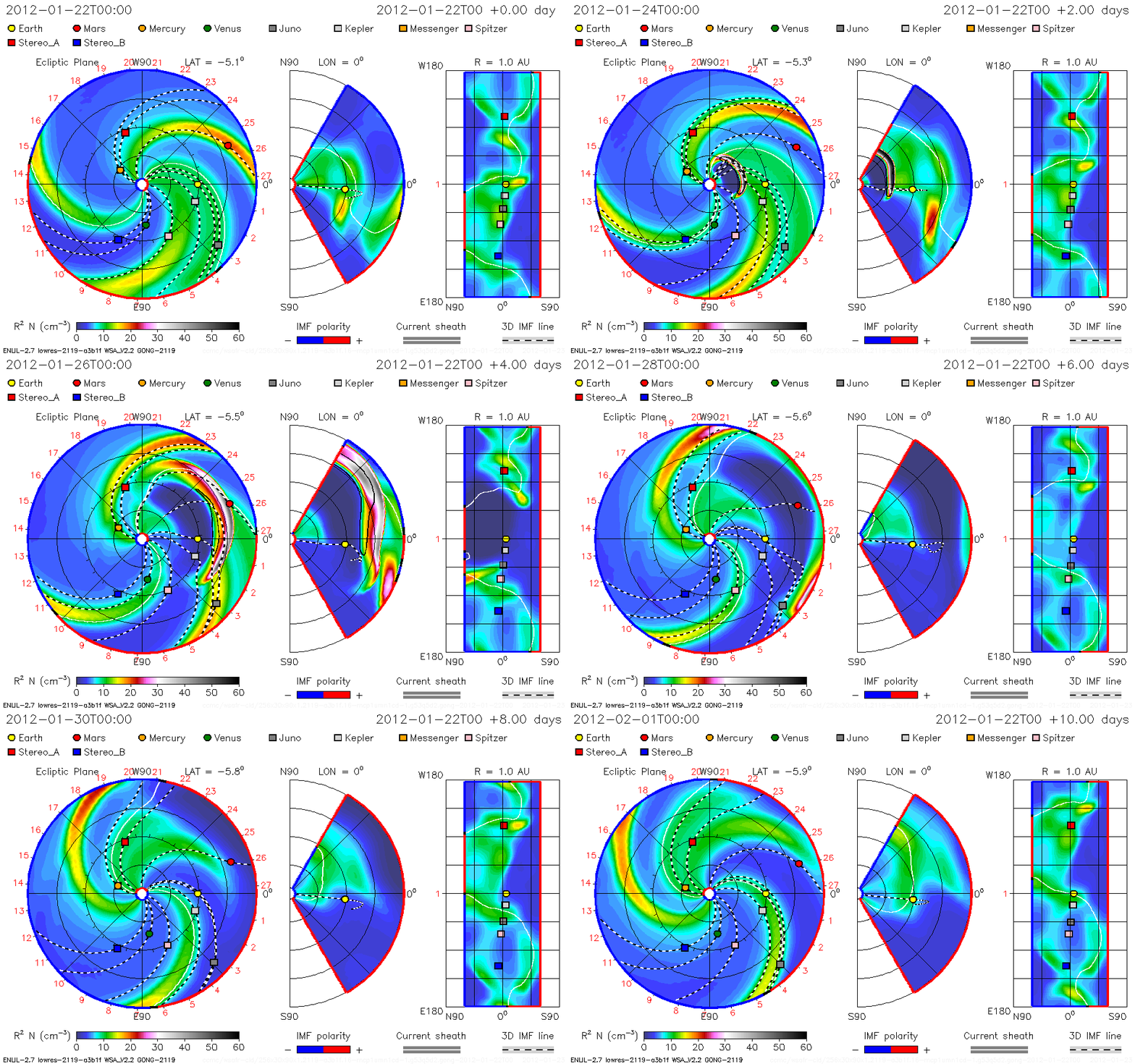
The flare was accompanied by a coronal mass ejection (CME), a cloud of solar plasma that was ejected from the solar atmosphere in the direction of Earth. The CME was observed by the STEREO and SOHO spacecraft with an initial speed of more than 2,000 kilometers (1,400 miles) per second. It was estimated to reach Earth sometime on January 24 and Mars on January 25. NOAA forecasters were predicting a G2 geomagnetic storm, though a G3 was possible.

Solar flares and CMEs are not a danger to humans on Earth's surface, as the planet's magnetic field (magnetosphere) and atmosphere deflect and absorb the solar energy and particles. The sun storms can pose some risks to astronauts, and they can upset the electronics and transmissions on science, military, and communications satellites. Closer to Earth's surface, solar activity can cause disruptions of radio signals (particularly HF), provide a small dose of radiation to passengers on high-latitude flights, and provoke auroras (northern and southern lights).

The storm is impressive by recent standards, but nowhere near the maximum intensities often generated at the height of the solar cycle. “I would expect that we will see more storms like this one or even bigger as we get closer to solar maximum,” said Michael Hesse, chief of heliophysics at NASA’s Goddard Space Flight Center.


Wednesday, January 25, 2012

Sun Flares with Activity

Solar eruption set to spark major geomagnetic storm today

The Sun Flares with Activity


Name: Ruben

Teacher: Mrs. J

Class: 6A

Date: January, 24th, 2012


Title: The Sun Flares with Activity


Source of Article: http://earthobservatory.nasa.gov/NaturalHazards/view.php?id=76998


Author of Article: Unknown


Date of Article: January, 24, 2012


Location: Sun


Main Idea of Article: The sun erupts explosions.

After a month of no sun activity, the sun has a storm again. The storm has the potential to disrupt some communications and satellite systems and to bring auroras to high-latitude skies. The high-latitude solar flare was measured as M8.7 in intensity, below the most intense “X class” of flares. Flare was accompanied by a cloud of solar plasma that was ejected from the solar atmosphere into the direction of Earth. I think that the solar plasma is very dangerous for us, and for our health. It will probably send some radiation to our atmosphere. I hope that nothing extreme will happen to our planet.

Friday, October 21, 2011

Haiti Earthquake Article


Earthquake in Haiti

Tuesday afternoon, January 12th, the worst earthquake in 200 years - 7.0 in magnitude - struck less than ten miles from the Caribbean city of Port-au-Prince, Haiti. The initial quake was later followed by twelve aftershocks greater than magnitude 5.0. Structures of all kinds were damaged or collapsed, from shantytown homes to national landmarks. It is still very early in the recovery effort, but millions are likely displaced, and thousands are feared dead as rescue teams from all over the world are now descending on Haiti to help where they are able. As this is a developing subject, I will be adding photos to this entry over the next few days, but at the moment, here is a collection of photos from Haiti over the past 24 hours. [See also Haiti 48 hours later]. (48 photos total)

Current Event 3


Name: Ruben
Teacher: Mrs. Jeftic
Class: 6A
Date: September, 30th, 2011

Title:
Haiti Earthquake
Source of Article:
http://www.boston.com/bigpicture/2010/01/earthquake_in_haiti.html

Author of Article:      N/A

Date of Article: January 12th 2010

New words: Displaced, Contented

Summary:

       On January 12th 2010 the horrible earthquake that was the strongest in 200 years struck Haiti. It was 7.0 on the Richter Scale and less than 10 miles from the city Port-au-Prince, in the country of Haiti. Houses were destroyed but some were still standing because there were a lot of pillars in the building and the buildings didn’t collapse because of the toughness of the pillars. Millions of citizens of Haiti were displaced and 86,462 were found dead. In Conclusion, this earthquake was very powerful but people that survived must be very contented that they survived but know people that survived know how to be safe at such enormous quake.

My Thoughts:
       I am unhappy because a lot of people died but I think that people should have made more buildings with more pillars in them. For sure it was horrible for people who watched their friends die during the earthquake.

Sichuan Earthquake Article

The 2008 Sichuan earthquake[9] or the Great Sichuan Earthquake was a deadly earthquake that measured at 8.0 Ms[1][10][11] and 7.9 Mw[12][13] occurred at 14:28:01 CST (06:28 UTC)[14] on Monday, May 12, 2008 in Sichuan province of China, killing an estimated 68,000 people.[15]
It is also known as the Wenchuan earthquake (Chinese: 汶川大地震; pinyin: Wènchuān dà dìzhèn), after the location of the earthquake's epicenter, Wenchuan County in Sichuan province. The epicenter was 80 kilometers (50 mi) west-northwest of Chengdu, the capital of Sichuan, with a focal depth of 19 kilometers (12 mi).[2] The earthquake was also felt in nearby countries and as far away as both Beijing and Shanghai—1,500 kilometers (932 mi) and 1,700 kilometers (1,056 mi) away—where office buildings swayed with the tremor.[16]
Official figures (as of July 21, 2008 12:00 CST) state that 69,197 are confirmed dead, including 68,636 in Sichuan province, and 374,176 injured, with 18,222 listed as missing.[8] The earthquake left about 4.8 million people homeless,[17] though the number could be as high as 11 million.[18] Approximately 15 million people lived in the affected area. It was the deadliest earthquake to hit China since the 1976 Tangshan earthquake, which killed at least 240,000 people, and the strongest since the 1950 Chayu earthquake in the country, which registered at 8.5 on Richter magnitude scale.[19] It is the 21st deadliest earthquake of all time.
Strong aftershocks, some exceeding magnitude 6, continued to hit the area even months after the main quake, causing new casualties and damage.
On November 6, 2008, the central government announced that it will spend 1 trillion Yuan (about $146.5 billion) over the next three years to rebuild areas ravaged by the earthquake.[20] (See also, China economic stimulus program.)


Current Event 2


Ruben
Mrs. Jeftic
Humanities
6A
September, 21st, 2011
Title:
Sichuan Earthquake
Source of Article:
Author of Article : N/A
Date of Article : May, 12th, 2008
New Words : Casualties
Summary

Sichuan Earthquake

The earthquake was a deadly earthquake which was measured 8.0 on the Richter Scale. After the earthquake there was 68,636 people dead from that earthquake. Then after the earthquake there were a lot of aftershocks and some were within the magnitude 6 a few months later after the main one. The main earthquake was on May, 12th, 2008. On November, 6, 2008 the central government announced that it will spend 1 trillion yuan ( $146.5 ) over the next 3 years to rebuilt areas ravaged by the earthquake.

My Thoughts  I think that this earthquake impacted a lot on the people from Sichuan, China. I like this article because it explains you a bit about how dangerous earthquakes could be. I am very sorry for the people who died while the earthquake was active.